Books change children's lives... for good!
Reading to Babies is Recommended
While reading to babies is recommended and healthy, teaching babies to read is not. Here is the diff
Reading to babies is a relational, language-rich interaction that supports brain development, attachment, and later literacy—not formal instruction in decoding words. The science distinguishes shared book reading (from birth) from programs that claim to teach infants to read. One builds the foundation through connection and spoken language; the other does not work as advertised and is developmentally mismatched.
What shared reading actually does
Babies are wired for language through live, contingent interaction—the “serve and return” of voices, faces, touch, and rhythm. Shared reading multiplies that input in a focused way. Parents talk more, use richer vocabulary, ask questions, label pictures, and follow the baby’s gaze and interest during book time than during most other daily activities. Even with preverbal infants, this produces more conversational turns and child vocalizations.
Longitudinal studies show that both the quantity and quality of reading in the first year and toddlerhood predict later vocabulary, oral language, emergent literacy skills (such as name writing), and reading readiness years later—before school entry. One estimate is that children read to daily hear hundreds of thousands more unique words by kindergarten than those who are not.
MRI research has linked greater home reading exposure in the preschool years to stronger activation in brain regions involved in semantic processing (extracting meaning) and mental imagery when children listen to stories. These networks support both oral language and later reading comprehension.
Beyond language, shared reading supports co-regulation. Close physical contact and the predictable rhythm of a familiar voice and story help synchronize heart rate, breathing, and attention. This calms the infant’s still-developing nervous system and builds the capacity for sustained focus. It also strengthens attachment, promotes prosocial behavior and resilience, and is associated with fewer later behavior problems. The American Academy of Pediatrics recommends starting at birth (including in the NICU when possible) precisely because the activity weaves language into the safety of a caregiver’s lap.
Print books outperform screens and many digital formats for this age because the adult can pace the interaction, follow the child’s interest, and maintain face-to-face engagement. Dialogic techniques (pointing, labeling, simple questions, expanding on what the baby notices) amplify the benefits, but even straightforward reading helps.
Why “teaching babies to read” is a different—and unsupported—claim
Programs that use flashcards, videos, or repetitive word-picture pairing to teach infants to decode printed words have been tested and found ineffective. A randomized study of one prominent product found no differences on speech processing, word learning, letter knowledge, or reading-with-meaning measures compared with controls. Parents often believed their babies were learning, but standardized assessments did not support it.
Infants can memorize some visual patterns, but systematic decoding (mapping letters to sounds and blending them into words they have not seen before) requires neural circuitry that is not typically ready until later—most children begin formal reading instruction around ages 5–7. Pushing decoding early can displace play, conversation, and joyful book sharing and risks associating reading with pressure rather than pleasure. Experts emphasize that a strong oral language foundation and love of books predict later reading success far better than early letter-sound drills.
Practical implication
The evidence-based practice is simple and low-pressure: hold the baby, follow their cues, use board books or cloth books with bold pictures and rhythm, talk about what you both see, and make it part of a soothing routine. The goal is connection and language exposure, not producing a toddler who “reads.” That approach aligns with how human infants actually develop language and regulation—through nested, responsive relationships rather than isolated skill training.

Endorsements for Reading to Babies
AAP Says...
1. American Academy of Pediatrics
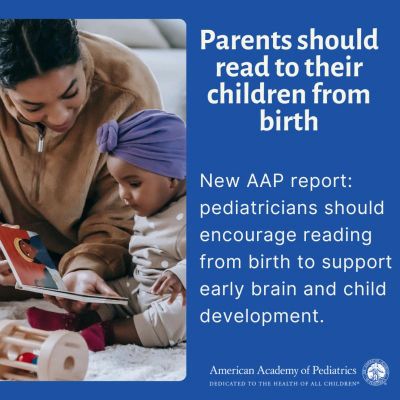
The AAP's current policy statement explicitly recommends reading aloud beginning at birth. It frames the practice as relational and language-rich, not as teaching babies to read. It specifically discusses cognitive, language, social-emotional, attention, and relationship development.
AAP: Literacy Promotion policy statement
The accompanying technical report is even more useful if you're looking for the science and bibliography. It discusses evidence beginning in infancy, mechanisms such as joint attention, exposure to language and syntax, labeling and pointing, emotional responsiveness, and the importance of the interaction rather than simply the book itself.
AAP: Literacy Promotion Technical Report
2. AAP's parent-facing guide: "How to Share Books With Your Baby"
This guide tells adults how to share books with an infant, including following the baby's attention, naming what the baby looks at, using facial expressions and voice, repeating favorite books, and interacting rather than insisting on finishing the story.
AAP/HealthyChildren: How to Share Books With Your Baby
3. Reach Out and Read
The AAP identifies Reach Out and Read as the most extensively studied model of literacy promotion in pediatric primary care. Importantly, its model starts with infants and emphasizes positive caregiver-child interaction around books, rather than infant reading instruction.
About Pam Leo's Book: Please Read To Me

Please Read To Me!
Please Read To Me is a multicultural, bilingual book that shows parents, grandparents, siblings, and caregivers the joys and benefits of bonding with babies and young children by reading to them. Featuring beautiful illustrations donated by Maine artists, the story is a child's plea for love and literacy. The rhyming text makes it fun to read aloud and young children enjoy the humorous and bright illustrations that reveal the whole story.
In addition to being an ideal birth and baby shower gift, Please Read To Me is a dynamic family literacy advocacy tool. The board book version ofPlease Read to Me was a recipient of two Stephen and Tabitha King Foundation grants and was distributed to Maine babies and children in 2021 and 2023. Find your free poster and family literacy resources at BookFairyPantryProject.org. All sales of this book support family literacy through the Book Fairy Pantry Project, a nonprofit initiative of Kindred World.
Now available in bookstore everywhere.
Support Pam's nonprofit work, and receive a discount, by purchasing Please Read To Me directly from her.
Buy Through International Booksellers:
Read a letter from Pam Leo about the book on Kindred Magazine.